

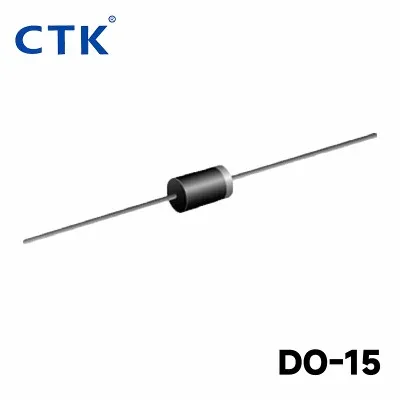
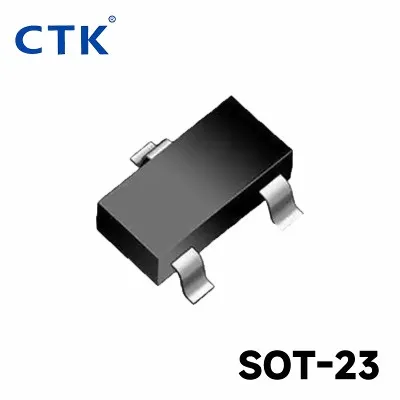
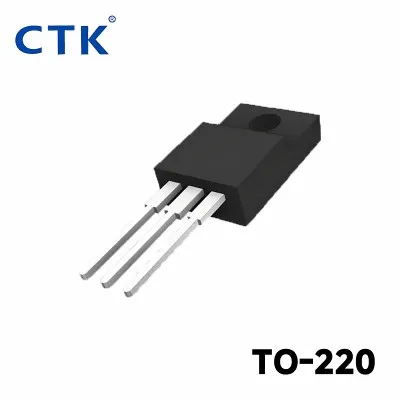

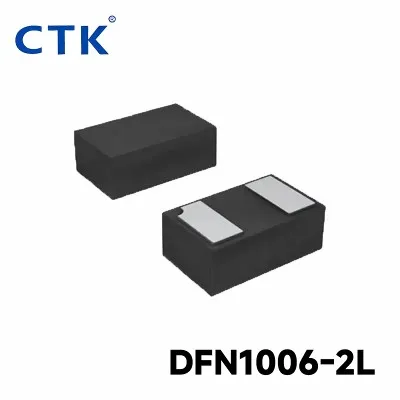
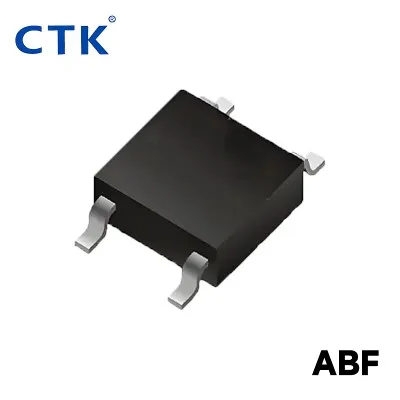


A diode is a two-terminal device composed of a p-type semiconductor (doped with trivalent boron) and an n-type semiconductor (doped with pentavalent phosphorus) connected by a p-n junction. Its core characteristic is unidirectional conductivity. During p-n junction formation, diffusion occurs due to the carrier concentration difference, creating an internal electric field pointing from the n-region to the p-region. When diffusion and drift reach dynamic equilibrium, the depletion layer is in a steady state. Under forward bias, the applied voltage weakens the internal electric field; once the threshold voltage is exceeded (approximately 0.5V for silicon diodes), conduction occurs, forming a forward current. Under reverse bias, the electric fields superimpose to form a small saturation current; excessive voltage can trigger avalanche breakdown or Zener breakdown.
Diodes are classified by material into germanium diodes and silicon diodes, and by structure into point-contact, surface-contact, and planar types. Point-contact diodes are suitable for high-frequency detection, surface-contact diodes are used for high-current rectification, and planar diodes are mostly used in switching and high-frequency circuits. Applications include rectification, limiting, and detection. Due to their small size and fast response, light-emitting diodes are used in display devices. Their forward voltage drop varies between 1.8 and 3.2V depending on the color of the emitted light.


